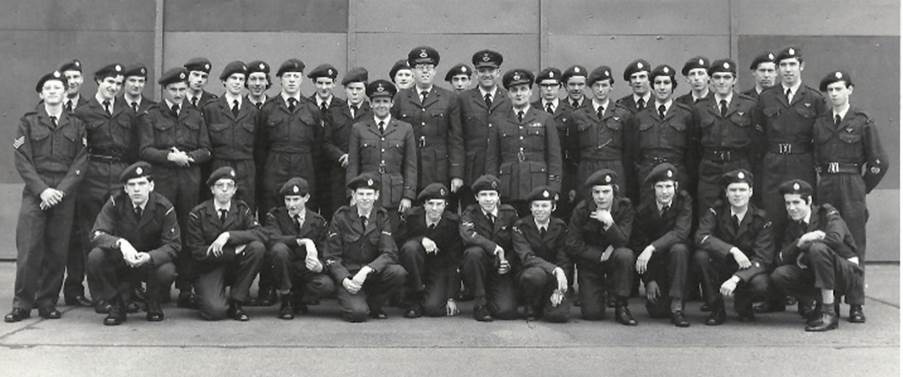
Memories of RAF Brüggen & Reed's School C.C.F. April 1974
Joining the CCF was compulsory on entering the Fourth Form, but one was conscripted only for one year, following years were voluntary, and unsurprisingly most people opted for the early de-mob. There was only so much square-bashing and blanco'ing of webbing belts that your typical 15-year-old could take!
But, my Dad had flown in Lancasters during the war, I loved airplanes, all I wanted to do was fly them, hang out with them, watch them. I was going to be a pilot, so the khaki uniforms were definitely not for me! I of course decided that I was going to join the RAF section. Whereas, true to form, at the end of our conscripted year, most of my mates decided that they had had enough, I stayed on. Amongst other things, I found out that I was actually quite good at close-order drill, a reasonable shot with a WWI vintage Lee Enfield .303, and I loved looping the loop with a roll off the top in a Chipmunk at RAF White Waltham. I couldn't get enough of that!!—(see below)
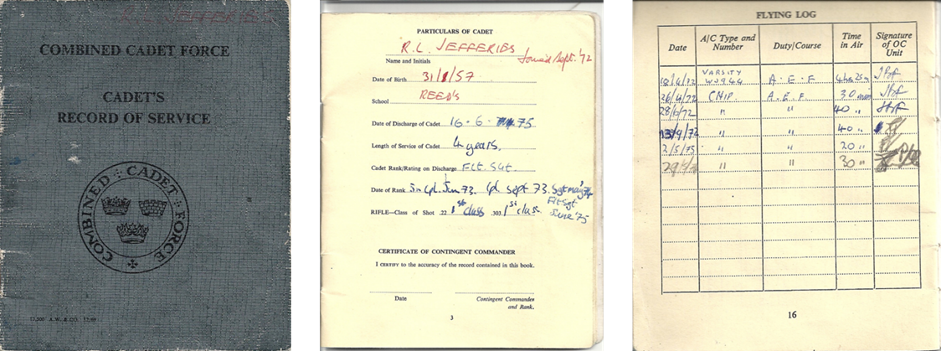
In fact, the CCF was a pretty good way to spend Monday afternoons. One such afternoon, Steve Dewey and I were clearing out the stores at the back of the CCF hut, when we came across a crate of rations destined for the Normandy beaches in 1944, (how they came to be in our hut is anyone's guess!). Steve withdrew his Swiss Army knife, and seconds later a tin of thirty-year-old Salisbury Steak was being consumed with relish. Our verdict—better than the average lunch served in the Reeds' dining room.
We saw, and did, a lot in the CCF, with opportunities to do stuff that didn't come the way of most of 15-18 year olds. I went to my first disco while on a camp at RAF Finningley, near Doncaster. Danced with a girl for the first time (her name was Primrose, and it was to "Brown Sugar" by the 'Stones). As we had been expressly instructed that the bars and clubs of Doncaster were strictly off-limits, Dave Haydon and I had to climb out the Gents' window when someone announced the MPs were on their way. I never did know what became of Primrose!
I learned to fly Gliders at RAF Manston, near Canterbury. It was the closest WW2 airfield to the enemy coast, it had a very long runway, and was used as an emergency landing site for our bombers that had taken somewhat more than a "bit of flak" during their missions over Germany. As it turned out, my Dad had actually crash-landed there himself in his Lanc, having had most of their tail shot off by flak over the U-Boat pens in Kiel.
But one event stands out in my memory—our visit to RAF Brüggen, in April 1974. Led by Flying Officer Eric Hearle, a.k.a. Deputy Head of Blathwayt and member of the Chemistry staff, [and whom Rest In Peace, Ian], yours truly, Chris Wilson, Adrian Bunnis, Richard Watson and 30 or so of our Reed's colleagues boarded our British Caledonian DC-10 and headed for West Germany.
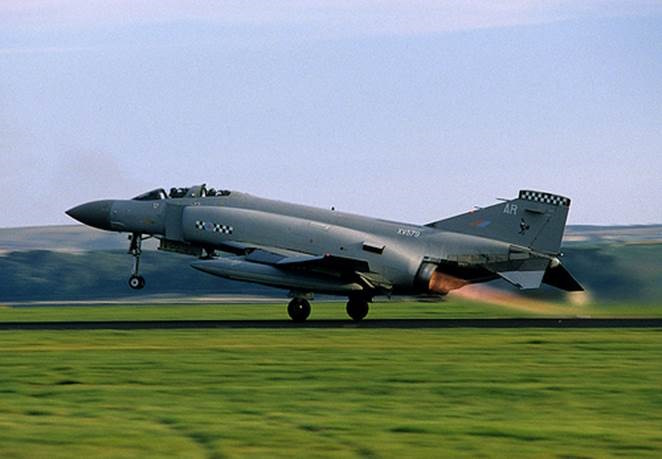
RAF Brüggen was a cold-war, front-line nuclear strike/attack base, equipped with several squadrons of F4 Phantoms. Upon our arrival we were met by a no-nonsense Flight Lieutenant (how I wish I could remember his name) and given a briefing that I remember well to this day, it went something like this:
"Gentlemen, welcome to Brüggen. This is a front-line station on a constant state of high alert. In the event of a Soviet invasion of Western Europe, squadrons of Phantoms will be scrambled, potentially armed with nuclear weapons. So, if you hear the sirens, make yourself scarce, do what you are told immediately, and don't get in the way.
"Secondly, under no circumstances will you visit the bars and 'certain shops and facilities' in the local towns. Is this understood?"
My first work-assignment was to assist in the maintenance of the Phantoms stood down from readiness. I was taken by one of the off-duty pilots to the appropriate hangar, and we started to chat about life on the front line. He was very matter-of-fact, and told me that if the sirens did go off, what you really didn't want to hear was "this is not a drill" being simultaneously broadcast with the siren. "Why would that be?" I innocently enquired. "Because we wouldn't have an airfield to return to after our sortie. Right, let's get to work," was the reply.
So, suitably chastened, and armed with my pneumatic screwdriver, I set about unscrewing the access plates beneath the cockpit of my first Phantom. My first attempt nearly ended in a "ground ejection"—the panel screws had been painted over, so I couldn't get purchase with the screwdriver in the screw head. Pushing with all my strength, I gave the pneumatic trigger full pressure, the driver kicked in my hand and dug a deep furrow 18 inches up the metalwork of the fuselage towards the red danger triangle that apparently you do not tamper with! Stepping back in horror to admire my handiwork, I looked around waiting for the hand to clamp on my shoulder and march me off somewhere unpleasant. No one had noticed. I carefully laid down my equipment and quietly sauntered off, to hopefully do less damage to another of Her Majesty's hugely expensive aircraft.
Suddenly, the air was rent with the loudest sirens imaginable. I melted into the shadows and slipped out of the door of the hangar, facing onto the threshold of the main runway. What unfolded in front of me was mesmerising and awe-inspiring: 12,000 lbs of thrust per engine, two engines per plane, eight planes, all taxiing for immediate departure.
Then, over the loudspeakers came the words: "this is not a drill, repeat, this is not a drill." I heard the words, but I could not tear my eyes off the drama unfolding in front of me. 500 hundred soviet tanks could be bearing down on us, or nuclear weapons could already be inbound, but I was fixed to the spot. Those Phantoms were at the same time the most wonderful and most dreadful sight I had ever witnessed. One after the other in rapid succession they turned onto the runway, throttles to full, rolling, acceleration like I couldn't believe, then, each in turn, they lit their after-burners.
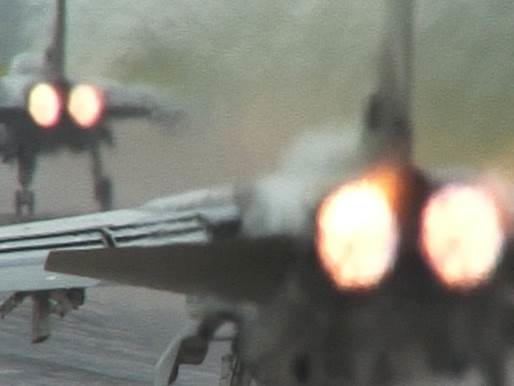
As raw fuel pumped directly into hot engine exhausts, 12,000 lbs per engine became 18,000. Sixteen of the most powerful engines in the world hurling 8 breathtaking machines skyward, to defend the free world. My insides turned to liquid as the noise and the shockwaves washed over and through my body. As the 8th Phantom disappeared into the clouds, the flames of its burners carving a tunnel through the dank misty sky, I suddenly felt terribly, terribly alone. An armoured vehicle raced towards me, halted, and a sergeant demanded, "Just what the hell are you doing? Get in!"
We ended up in flight dispersal, I seem to remember it was at the base of the stubby airfield control tower, with hugely thick walls and small windows, but to be honest, life at that point was a blur, just noise and movement. I stood silently, alone against the wall for goodness knows how long, when I realised I could hear inbound fast jets. Ours? Theirs? Will I make it to supper? Then clarity, I could hear, see, think. These were our Phantoms returning, I presumed that was good news. It was for me certainly, although I learned later from my pilot friend, that this had been the once-a-year "this-is-not-a-drill, drill". It turned out that the boys had done well, but not well enough. Eight Phantoms, ready for WW3, had to be airborne from scramble to wheels-up in less than 5 minutes. They had missed the target, the Base Commander was going to "have a word." I on the other hand thought they were heroes, and to this day I can still feel the ungodly power of those engines, and how close we really were to Armageddon in the years after the Second World War, right up until the Wall finally came down in 1989.
Later on in our tour at Brüggen, Chris, myself, and a number of the boys decided that a visit to the local town would be in order, for "cultural" purposes. The bus, very conveniently, stopped at the base gates, and again, right in the heart of town. It took no time at all before cool German draughts were washing their way down thirsty young English throats. Suitably refreshed, a wander around town was called for. I won't draw this out, it was nowhere near as dramatic as my "scramble" of a few days earlier. Suffice to say, that a few, unnamed RAF Cadets ended up in one of the "shops" that were off-limits, purely for educational purposes (and boy was it educational!). And who did we bump into immediately therein? Yes, you guessed it, our very own Flight Lieutenant. Looks were exchanged, and we beat a hasty retreat. It was a funny thing though, for the remainder of our stay, our Flt. Lt. couldn't have been nicer to a certain section of the Reed's contingent. No one could figure out why, and we certainly weren't going to tell them.
Footnote 1:
Roll forward to late 2015. I was at a local social event, and got talking to a chap a few years older than myself, only to discover we shared a mutual interest in flying. It turned out he was a retired airline pilot. We had an amiable chat, and I asked if he had started out in the RAF? Indeed he had. Fast jets I enquired? Yes, indeed. Ever posted to RAF Brüggen? I wondered out loud. Certainly was, as a Flight Lieutenant, 1973-1976 in Phantoms!! As I said, I wish I could remember the name of "our" Flt. Lt. How small the world got at that moment I will never really know.
Footnote 2:
On the 4 September 2007, the British military admitted that there had been an accident with a nuclear weapon at RAF Brüggen on 2 May 1984. The nuclear weapon fell from a transport truck, as the missile wasn't securely attached to the truck. The weapon was 8 times more powerful than the bomb that was dropped on Hiroshima in 1945. The casing was x-rayed after the incident, and found to have been undamaged, a testament to the inherent strength of nuclear weapons casings. The six people who were responsible for the accident received a reprimand for their actions in the incident. (Courtesy Wikipedia)
Final Footnote:
Thanks to my wife Debbie, I do fly airplanes now, mostly Piper Warriors from Fairoaks airfield, near Chobham in Surrey. I had to wait until my 50th birthday to realise the dream. But trust me, it was worth the wait. I would though, give anything to get my hands on a Phantom!
Richard Jefferies. September 2016